.png)

Read Time : 14 Minutes
How much do Solar Panel Systems Cost? UK Prices 2026
A standard 4kW solar PV system in the UK will typically cost £5,500 to £8,000+ in 2026. Roof type, location, and installation complexity can affect the final costs.
Payback periods are generally between 6-10 years with annual electricity savings of around £500 - £700 PA. This is based on usage patterns, export tariffs, installation costs, and other factors.
Adding a solar battery can increase your energy independence, reducing your electricity bills by up to 70%, but will significantly increase your initial outlay and can extend the payback period.
A 4-5kWh solar battery will typically cost between £3,000 - £5,000. The 0% percent VAT scheme can save between £1,000 and £3,000 on the final installed cost.
The average price for a solar panel system with battery ranges from £8,000 to £14,000+. Initial outlay can be higher depending on various factors which we discuss in the article below.
Getting an honest, straightforward answer to 'How much do solar panels cost in the UK, and what's the potential return on investment?' isn’t always as easy as it should be. To get an accurate understanding of the figures, you'll need to research, obtain quotes from reputable installers, and - before signing on the dotted line - carefully consider which solution best suits your property and energy needs.
If you're ready to get an accurate price estimate for your home, check out our solar panel cost calculator. It's free to use, takes a minute to fill, and your don't need to add your contact details.
An optimal solar photovoltaic (Solar PV) system, when combined with a solar battery, can reduce the average UK household's electricity bill by up to 70% or more.
In this article, we cover the key factors affecting the initial outlay and payback periods, available grants and subsidies, and installation considerations with a detailed installation walk-through, and an in-depth look at solar battery costs.
Factors Influencing Solar Panel Costs
• The type of panels
• The size of the array
• The complexity of your system
• Aesthetics
• How much electricity you use
• How much electricity your system produces
• The suitability of your property
• Potential grants, incentives, and schemes
• Your negotiating skills and research
• Geographical location
• Solar storage
We’ll crunch numbers in a moment but before we do, let’s go through the list and explain why each factor is important.
Panel type: There are two basic variants of solar panels on the market, with a third about to land soon (nothing guaranteed yet though). These are monocrystalline and polycrystalline with Perovskite-silicon in development. Monocrystalline panels are dark, almost black in appearance and they're the current gold standard in efficiency. Polycrystalline are blue and less efficient, but cheaper than their cousins.
Perovskite-silicon panels are still largely in the “in development / early deployment” phase, and while they promise a quantum leap in efficiency… and likely price, widespread consumer availability is not yet guaranteed.
Size of your system: Check the wattage output of the proposed system. It's likely that the higher the output, the larger the price tag. A PV system should be sized for your needs and your wallet.
The complexity of your system: The market is improving all the time. Right now, there are a number of gizmos and gadgets to help upgrade the efficiency and application of your system… and its price tag.
Aesthetics: Solar PV panels are all much the same in terms of aesthetics. That said, if you want a prettier version with less obvious metalwork, thinner panels, or even solar roof tiles, you can add a few quid to your bill.
The availability of solar tiles in the UK is limited. It's a technology that's really still in development. Only a few UK solar companies offer a solar tile solution, so if you've got a listed property and there's no chance of panels, fill out a Contact Us form and we'll try to help.
In-roof or on-roof: If you're planning on replacing your roof tiles, or maybe it's a new-build project, in-roof solar panels can provide a more aesthetically pleasing solution. The panels sit in a tray, flush with the roof. This can help with attaining planning permission but it's worth noting that in-roof systems run a bit hotter than on-roof systems and due to this, lose a small amount of efficiency. You can expect to pay a bit more for an in-roof system but you could be making a good saving on roof tiles.
How much energy you use: A decent solar system can produce up to 70% or more of the power you need. If you end up paying for a system that exceeds those needs, expect a larger initial investment and potentially a longer pay-back period.
How much energy your system produces: Bigger systems cost more money… but the more energy you produce the more you can sell, and this can affect the bottom line. Although the Smart Export Guarantee isn't the money spinner the FiT was, it still helps towards your pay-back period and the standard tariff offered by the big energy companies has improved considerably.
The suitability of your property: For the most effect, you want an unobscured, south-facing sloped roof with no shade. Otherwise, expect to add numbers to the initial outlay and potentially your pay-back period.
Potential grants, incentives, and schemes: The glory days of the FIT are gone, but you may still be able to get a grant for your solar array. More info on this below.
Your negotiating skills and research: Good news, as you’re here you’re already one step ahead of the crowd. Now, also remember that the solar market is competitive so don’t be afraid to haggle.
Geographical location: Like they always say, location, location, location. In solar terms this is important for three reasons. First, the sunnier it is where you live the better chance you’ll have to generate power. Second, if you live in a pricier part of the country, you may pay more for the initial outlay. Third, some areas are more receptive to renewable energy than others. Scotland, for example have more grants and financial schemes available, while cities like Brighton and Hove with their Green council and MP can help you cut the red tape.
Solar batteries and when you install them: We’ll dive into this in a bit. It’s worth mentioning though, that solar storage and when you install it can really affect the initial price and payback period of your system. We’ll talk about this more later, but how VAT applies to solar batteries is another factor to consider.
Additional components to the system: If you’re considering installing additional components, you should take into account that although it will increase the initial costs, it may actually reduce your payback period. Whether you’re thinking about installing solar batteries or additional features like pigeon-proofing your panels, it is a good idea to combine them with installing the panels.
COMPARE PRICES FROM LOCAL INSTALLERS
Compare prices from local companies fast & free
Enter your postcode to compare quotes from leading professionals. We promise to keep your information Safe & Secure. Privacy Policy
Solar PV Installation Costs UK – Real Figures & Examples for 2026
Now, that’s out of the way let’s look at some numbers and solar panel prices. The infographic below will give you a good idea of approximate costs.  Starting with some base figures, solar systems in the UK start around the £3500 mark but often top out at £20,000. To put that in perspective, let’s look at a case study of a typical UK house.
Case Study: solar panel installation for an average UK home
• House type: Semi-detached
• Solar panels: polycrystalline 4kW
• Number of panels: 10-14
• Solar panel cost, including installation: £7000.00 (Actual price ranges from £5,000 to £9,000)
• Estimated annual output: 3600 kWh (South of the UK)
• Estimated Smart Export Guarantee Tariff: £50.00 (SEG tariff £0.25 pp kWh)
• Estimated savings on fuel bills: £952.00 PA (3400 kWh * £0.28/kWh)
• Total Savings/Earnings in a year: £1,002.00 PA (£952.00 savings + £50 SEG income)
• Payback period: 6.99 years
Please note: these figures don’t account for future electricity price changes (up or down), so your savings and payback period can be shorter or longer over time.
These figures estimate that you used 3400 kWh of the electricity the system produces during daylight hours. We estimated 200 kWh exported to your energy provider. The payback period can be significantly different if you have lower daytime usage.
The Renewable Energy Hub has a Solar Calculator. The calculator asks several multiple choice questions about your home and energy usage trends, then provides a downloadable PDF with estimated initial costs and payback periods.
Click this link to access the Renewable Energy Hub Solar PV Calculator a full solar panels cost calculator.
How Long do Solar Panels take to Pay for Themselves in the UK?
Let's look a bit closer at installation costs with another example and a bit more detail on how the increase in electricity costs can affect the payback period.
• A household in the UK installs a 5kW photovoltaic system costing £8000 (average cost), which would generate approximately 4320 kWh of electricity annually.
• Assuming you use 50% of the electricity and you're paying around 28 pp kWh (pence per kilowatt hour) and selling the other 50% to your energy provider for let's say, 15 pp kWh. (a leading utility company's current SEG tariff)
• The electricity bill saving would total £604.80 PA (electricity used in your home - 2160 kWh x 28p - this is the electricity that does not need to be bought from a utility company)
• The annual SEG income in the UK would be £324 per annum.
• Without assuming any future price rises or falls, this totals £928.80 per year creating a simple pay-back period calculation of 8.61 years.
• If we add in the average increase in the price of electricity in the UK every year, the total saving or ROI over twenty years would be £28,619.15
It's certainly worth noting that the price of electricity per unit was increasing by 3.6% per year until 2022 when we saw a huge jump. In reality the cost of electricity per unit has nearly doubled in 10 years, or 9% per year on average!
According the the gov.uk website, the average cost per kWh in 2014 was 14.4p, now you're lucky to get a 22.5p tariff. Electricity prices have been volatile in recent years. For example, Ofgem’s standard variable electricity unit rate for the price cap period 1 January to 31 March 2026 is 27.69p/kWh (direct debit, typical regional averages vary).
All these figures are approximate but give you an idea of how the costs and pay-back periods can be worked out.
Adding a battery into the mix brings a bunch more variables but the same sort of calculations can be made. Check out our page on the best batteries for solar panels.
| Property Type | Approx. Roof size | Approx System size | Average System cost | Co2 Saved Per Year (tonnes) | Approximate Yearly System output |
|---|---|---|---|---|---|
| Terraced | 8m² | 1kWp | £ 2500- £3000 | 0.5 | 900 kWh |
| Semi-detached | 15m² | 3kWp | £ 3000- £4000 | 1 | 2,700 kWh |
| Average detached | 28m² |
4kWp |
£ 6000- £8000 | 1.5 - 2 | 3,600 kWh |
How Location & Usage Affect Solar ROI in the UK
Don’t forget that your location will also play a part in your return on investment (ROI). If you live in an area with more sunlight hours, (e.g. Devon or the South Coast) or higher traditional fuel costs (e.g. London), then you’ll pay off your system faster.

Are there any Hidden Costs when Installing Solar Panels?
You may be wondering if there are any hidden costs that haven’t been mentioned when installing a solar panel system in the UK. There are two other potential costs you should look into before installing solar panels, these are maintenance costs and repair costs.
For general maintenance and check-ups, it is advisable to ask your installer or another certified professional for an annual service which will usually cost between £100 and £200 and is worked out on an average of £9.50 per panel. Your location, the type of panels and the age of your system can affect this price.
Though paying this is unlikely to be an annual requirement, many solar installers will recommend a yearly check-up to ensure there aren’t any changes in the condition of the panels.
Solar panel systems are low maintenance because they have no moving parts. For this reason, you are unlikely to ever have to repair or replace any parts of your solar panel system. There is however one component that will most likely need to be replaced during the lifetime of your solar panel system and that is your inverter. They usually only last 10-15 years. You should set aside a budget of between £500 and £1,500 for this.
Most top solar manufacturers will offer warranty periods of 20-25 years so if anything happened to your panels you would be covered anyway. These warranties cover the repair or replacement of panels if there are defects in materials or workmanship. They do not cover for exp, damage from falling objects, storm damage or vandalism. It’s always wise to check the terms of your warranty before going ahead with the installation so that you are prepared.
How Much do Solar Batteries Cost?
Solar batteries are definitely groundbreaking when it comes to the renewable energy landscape in the UK. They provide homeowners with a number of benefits, including long-term savings on energy bills, greater energy independence and a significant contribution towards a greener planet.
The cost of a solar battery in the UK will vary depending on the capacity, brand, and installation requirements. A solar battery allows you to store the excess electricity you generate during the day so that you can get even more out of your solar panels by using this stored electricity on cloudy days, when the sun has gone down, or at times of peak demand.
The size of solar battery you’ll need in the UK will depend on your home energy consumption. The greater the capacity of your battery, the more electricity it can store, though this will naturally come with a higher price tag.
Adding a solar battery storage system will of course increase your overall solar panel investment but you will gain by using on average an extra 30% of the solar energy your panels generate to power your home. However, your payback period can be extended, the battery will need to be sized for your requirements, and you will probably need to buy two batteries over the 25–30+ year lifespan of your solar panel system.
As the average cost of a solar battery for a three-bedroom house is £4,500, it means you could pay £9,000, or more for batteries over the lifespan of your solar panels.
The average package 3kW or 4kW solar panel system with battery, usually comes with a 4kWh to 14kWh battery. The average price of a solar panel system and battery ranges from £8,500 - £14,000 but can be considerably higher depending on the battery.
If you want to include a storage solution you are going to have to pay more upfront. However, adding a battery could reduce your electricity bill by as much as 70% - 100% especially if you have low daytime, and high nighttime usage.
Solar battery storage prices can range from between £2,500 and £10,000 with the best solar battery brands tending to start from £4,000 upwards for 3-4 bedroom homes. The cost of the battery will depend on the battery type, lifespan, and quality.
Installing a solar battery will significantly reduce your reliance on the National Grid with the average household cutting its grid electricity by 73%.
Before you go ahead and purchase a solar battery you need to weigh up the potential savings against the cost of installation and how long the battery will last. Your installer can help you with the details about the potential cost savings and all the information you need to make the right decision for you.
Battery technology is constantly developing, and batteries will likely last longer as the technology develops. You could potentially save even more money if you combine your installation with the advantages of a smart time-of-use tariff. Smart time-of-use tariffs are a type of pricing structure that varies the cost of electricity based on the time of day you use it. The savings you can make will depend on how much you’re able to shift your electricity consumption outside of the peak hours.
There is one useful scheme available to help offset the cost of investment in solar batteries which is the 0% VAT rate for energy-saving materials. Which is now applicable whether you buy the battery with the panels, or separately.
Incentives and Schemes: Solar Panel Grants
As you'll see, these initiatives tend to come and go, and are often not accessible to everyone. If no current schemes are available to help with upfront costs, the Smart Export Guarantee (SEG) is still an option for most - provided you meet the eligibility criteria.
Check out our article: 'A Guide to Solar Panel Grants and Funding in the UK (Jan 2026)' for an in-depth look at what's available.
Feed In Tariff scheme (FIT)
The Feed In Tariff (FIT) closed for applications in 2019, but if you buy a house with a solar array in place it may still apply. FIT was a generous incentive that paid solar users a tariff for all the energy they produced (the generation tariff) and a bigger tariff for the energy they sold back to the grid (the feed-in tariff). In 2020 the government's new scheme, the Smart Export Guarantee (SEG) replaced FIT. Although some FIT tariffs exist for folks who signed up before the program closed.
Smart Export Guarantee (SEG) with Table of UK Rates
Like FIT, SEG pays solar owners for energy they sell back to the grid. Unlike its predecessor SEG doesn’t pay anything for total units produced, only for each unit that's sent back. SEG tariffs vary from energy supplier to energy supplier and come in the form of variable or fixed rates. There is no guaranteed minimum annual payment under SEG — instead, SEG export tariffs must be above zero, and suppliers set their own rates and terms. Typical earnings depend on your export volumes, tariff, and how much solar you self-consume.
You will normally need an export meter (often a smart meter that can provide export readings), plus MCS certification, to benefit from the SEG.
The table below shows the Smart Export Guarantee (SEG) rates for UK Energy Suppliers. (Rates change frequently — please check directly with suppliers before relying on them.)
| Energy Supplier | SEG Rate (p/kWh) | Tariff Name | Customer Requirement | Notes |
| Octopus Energy | ~29.4 (peak) | Intelligent Octopus Flux | Octopus customers with compatible battery | Time-of-use tariff — highest peak rates seen (~29p) |
| Octopus Energy | 20-27 | Octopus Flux | Octopus customers with battery | Flux is time-of-use and variable by time band |
| OVO Energy | ~20 | SEG Install Exclusive | OVO electricity & solar/battery | Conditions apply (up to 20 depending on install partner) |
| So Energy | ~20 | So Bright | So Energy customers with battery | Higher “installed by” tariff (depending on install / product version) |
| Good Energy | ~12-15 | Solar Savings Exclusive | Good Energy customers with battery | Customer tariff — varies by product |
| British Gas | 15.1 | Export and Earn Plus | British Gas electricity customers | One of the highest fixed SEG rates from major suppliers |
| Octopus Energy | 15 | Outgoing Fixed | Octopus customers | Fixed-rate non-battery export |
| EDF Energy | ~13-15 | Export 12m / Export Exclusive | EDF electricity customers | Typical fixed tariff offering ~15p |
| OVO Energy | 15 | OVO SEG tariff | OVO customers | Standard SEG for customers |
| Scottish Power | ~10-12 | SmartGen / SmartGen Premium | ScottishPower customers | Tiered tariffs (~12p on premium versions) |
| Utility Warehouse | 8 | UW Smart Export Guarantee (Bundle) | UW Energy + 2+ additional UW services | Enhanced export rate for multi-service bundle customers |
| So Energy | 4.5 | So Export Flux | None | Lower variable export tariff |
| Octopus Energy | 4.1 | SEG Tariff | None | Standard open export tariff |
| OVO Energy | 4 | OVO SEG Tariff | None | Standard supplier export tariff |
| Good Energy | 4 | Export Only | None | Basic open export tariff |
| British Gas | 3.02 | Export and Earn Flex | None | Lower flex rate for non-customers |
| EDF | 3 | Export variable | None | Variable non-customer export tariff |
| Utilita | 3 | Smart Export Guarantee | None | Standard low export tariff |
| E.On Next | ~5–16.5 | Next Export / Next Export Exclusive | Mixed — varies by product | Some E.ON tariffs range from ~5p (open) up to ~16.5p for customer-linked tariffs |
| Utility Warehouse | 2 | UW Smart Export Guarantee | None | Basic standalone export tariff |
* This table is accurate to the best of our knowledge on 01/04/2026. (Rates change frequently — please check directly with suppliers before relying on them.)
Free solar panels UK
Past schemes allowed solar suppliers to offer free solar systems in exchange for their Feed In Tariff revenue. Alas, as FIT is no more most of these deals died with it. You may still be able to find a company prepared to loan you the money to fit solar panels though. Finance for these loans came from the potential savings from your energy bills. The idea is the money you saved on lower bills would cover the interest payments but be cautious they're still loans.
ECO4 and LAFLEX
One 'free solar incentive' still online is the government's Energy Company Obligation or ECO program. Now in its fourth iteration, hence ECO4, the Energy Company Obligation and its subsequent upgrade LAFLEX (Local Authority Flexibility) nudged energy providers to help improve low energy efficient households. Depending on the criteria, it's still possible to get finance to make improvements like installing solar panels through the ECO4 initiative. LAFLEX, despite its exotic-sounding acronym, was added later to give local authorities added flexibility in helping more folks qualify.
For more information about the ECO4 initiative, click here.
You can find out more here...
https://www.gov.uk/government/consultations/design-of-the-energy-company-obligation-eco4-2022-2026
Home Energy Scotland Grant and loan
Home Energy Scotland funding rules have changed: solar PV and battery/energy storage support has been restricted, and “solar-only” applications have not generally been eligible for some time. Always check current eligibility and what measures are currently supported before making plans. As with all legislation and regulations these funds are prone to change and it's important to always keep up to date with them.
Cash is king!
If you have the capital, the smart way to get solar is to pay for it outright. Buying your solar PV system upfront means you can recoup the cost from the start. This offers a better ROI than leaving the money in the bank. If you don’t have the cash to hand, however, it’s worth considering a loan. Make sure to calculate any interest payments on finance when working out your pay-back period.
No VAT for Solar Panels or Solar Batteries!
It's fair to say that despite the government's best efforts, most of the official incentives are opaque at best. It's worth taking time to understand the current rules, pitfalls, and loopholes. One incentive that's fairly straightforward is the government's list of energy-saving materials that benefit from VAT relief. Up until Feb 2024, you would only get VAT exemption for batteries when installed in combination with solar panels. Now, retrofitted, and stand-alone solar battery installations can also benefit from a 0% rate of VAT (subject to the scheme rules). A saving of 20%!
Finance options for solar panels in the UK
Many companies offer finance for solar technology in the United Kingdom. Finance, loans and leasing agreements are available for domestic, commercial, and industrial installations.
Finance for renewable energy technologies spares you the need to tie up capital in your system. A typical solar system would pay for itself over its lifetime including any interest but make sure you consider interest payments when working out a payback period.
Of course, all finance options involve an element of risk, but some providers offer to offset that risk by owning the solar system from the out. This is rare these days though and usually reserved for commercial installs.
Rates and offers vary and it’s always wise to seek independent financial advice before embarking on such a scheme.
Solar Together and group buying options
One nifty new idea in the renewable energy market is group purchasing. There are now organisations out there like Solar Together. These groups unite like-minded folks looking for solar panels before auctioning the bulk contracts to vetted lists of suppliers. Of course, you don't need any help to pop next door to see if you can't come up with a joint plan, in the same way you might chat about joint roof improvements. Depending on your initiative, you might want to take the idea a little further like Walthamstow couple Dan Edelstyn and Hilary Powell. The pair slept on the roof of their London home for 23 nights in late 2022, in a bid to raise £100,000 to install solar panels for their whole street. Of course, you don't have to go quite the same lengths as Dan, and Hilary whose efforts also included releasing a top 21 song and camping out on their roof. Still, you never know where a quick cup of tea with the neighbours could lead.
https://www.bbc.co.uk/news/uk-england-london-64151663
https://solartogether.co.uk/info/about-us
Solar Thermal Systems and Solar Diverters
Two solar panel systems dominate the market at present and both work in different ways.
Solar PV systems: A solar PV system is what most folks think of when they think about solar power. They work by collecting the sun’s energy through their PV (photovoltaic) cells. This energy is then converted into electricity.
Solar thermal systems: By contrast solar thermal systems use the sun’s energy to heat a special transfer fluid. This liquid then transfers that heat through a heat exchanger to generate hot water.
There are upsides and downsides to both systems. In simple terms though, solar thermal systems require thermal heat from the sun and don't do much in the winter, although they are generally cheaper to install. Solar PV systems will generate electricity just from light.
A typical 4kW solar PV system in the UK may generate more electricity than you need during times of peak generation. Solar diverters optimise the usage of the energy generated by your solar PV system. They redirect excess electricity to heat water for your home, mostly for domestic hot water supply like showers and hot taps. This can work out much better financially than sending the excess back to the grid for the SEG.
Solar diverters are relatively inexpensive when compared to other system additions such as solar batteries. Solar diverters cost on average £300 - £500 in the UK.
Solar Panel Installation Process
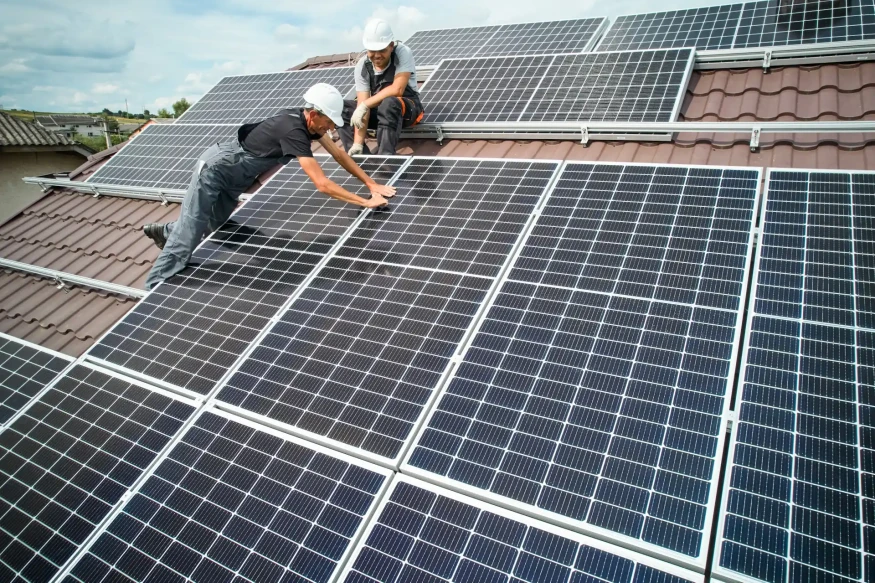
Proper training and equipment are required to safely install a solar panel system. The process can be divided into 7 steps as follows:
Step 1: Firstly, the solar panel installers set up scaffolding around the house for safe access to your roof. This will usually take about 3 - 8 hrs.
Step 2: Once the safety measures are in place the solar panel mounting system is installed. Roof anchors and an aluminium frame that will hold your solar panels in place are attached to the surface of the roof providing a stable foundation.
Step 3: The panels are then placed on the mounting structure. Before they are secured, they are positioned or angled to maximise the sun’s energy they can receive and absorb, namely south-facing at a tilt of 30° to 40° (preferrably). Bolts are tightened to keep the panels in place.
Step 4: The next step is to secure the electrical wiring which can vary depending on the model. Most panels come pre-wired from the manufacturer for easier installation but it's still always best to have this step performed by a qualified electrician. The household’s electricity will be switched off before working on this step.
Step 5: Solar panels are wired and connected to the solar inverter so that the energy they produce can be used in your home. The solar inverter is installed near the consumer unit or in a garage. This part of the process can take between 4 and 6 hours depending on how complex the solar panels are. This part must be set up properly because the direct current (DC) electricity will be converted to alternating current (AC) electricity. A generator meter can be connected at this point to track how much electricity you generate each day with your solar panels.
Step 6: The solar inverter is connected to the consumer unit to generate electricity. If you’re also adding a solar battery to your solar panel installation, this is when the inverter and the battery are connected, allowing for energy storage. Once everything is connected to the consumer unit and grid input, the connected generation meter can be checked for its performance.
Step 7: The installers conduct final checks and tests to ensure that your solar panels are functioning properly and properly producing energy. Each panel is checked and monitored. Once this is done, your solar system installation process is complete!
Are Solar Panels Worth Installing in 2026?
The true upfront costs, savings, and return on investment of installing a solar system come down to you, your location, and your lifestyle choices. However, if you decide to proceed, installing a solar system in the UK is an excellent investment. Take your time to consider the best path because installation costs can vary widely, and don’t rush the decision.
It’s worth reading our excellent mega guide which we’ll link to in a moment. In that guide, you’ll find a section all about the considerations you need to factor in before getting your bank card out. If you have the perfect situation, i.e. you live on the south coast, have a south-facing roof, and cash in the bank, then you probably already have solar. If not… well, get on with it! For the rest of us, you’ll need to factor in the mitigating conditions we’ve discussed above.
Since you’ve come this far, and thanks for taking the time to read our guide by the way, (*cough… a share? Why that would be lovely…) then please look at our solar panel mega guide. This link takes you to our comprehensive up-to-date solar guide.
We also have these related guides:
How much space do I need for solar panels? (This article has useful information about pay-back periods)
How much electricity does a solar system produce? (This article helps explain what you can expect your system to produce)
Find a local installer
Welcome to the biggest directory of UK renewable energy companies
 How much do Solar Panel Systems Cost? UK Prices 2026