.png)

Read Time : 7 Minutes
How many Solar Panels do I need? A 2026 Guide for the UK
How many solar panels do I need? Divide your daily electricity use (kWh) by the expected output of each panel to estimate how many panels your home requires.
How much power does a typical system cover? A 3.5–4.8kW system (around 8–12 panels) can usually cover 50–70% of the average UK household’s electricity use.
What affects the number of panels needed? Your annual energy use, panel wattage, sunlight hours, roof direction and shading all influence how many panels you’ll need.
This guide focuses on estimating how many solar panels your property may need based on energy demand. For roof size requirements or system costs, see our related guides.
If you are looking at investing in solar panels, then you will likely have some pressing questions before you proceed. The information in this article is based on data from 850+ UK installation companies.
Firstly, the obvious stuff. They are a brilliant way to provide energy for your home, lower your bills, and reduce reliance on the grid. Plus, they are environmentally friendly and require hardly any maintenance. However, before you buy, it is important to have a good idea of how many solar panels you may need. Make sure you consult a professional and accredited installer about this, but this article can make sure you're well informed before going out for quotes.
Calculating the size of the solar panel system needed for your home involves a few important steps. Understanding your energy requirements, solar panel efficiency, how sunlight affects generation, and the perks and pitfalls of your roof space are all necessary considerations when choosing the right size solar PV system for your property in the UK. This article will help you make an informed decision moving forward.
Does your budget affect how many solar panels you can install?
Generally speaking, the size (in kW) of the array is limited by two factors, space and budget. If your roof is small, then there will be a limit to the amount of electricity you can generate. You can squeeze more out of this available roof space by installing more expensive panels that generate more energy per m2 but as most people are looking to achieve an attractive payback period, you have to weigh this up carefully.
A 4kW solar PV system has become the standard for the UK and will usually cost between £5,000 and £7,000 as a rough guide. These systems will usually come with a 3.6kW inverter. This is because the system will never really reach its peak power rating. This is due to the weather conditions here in the UK never really reaching optimal performance.
It's important to note before we get into it that If, like most of us, you're on a single phase electric supply, then 3.68kW is the max inverter size you can have without District Network Operator (DNO) permission. Anything up to that size of inverter falls within the 'fit and inform' category. Don’t let that deter you though, the benefits of a larger system will outweigh the time and cost in most circumstances and If you have a three-phase connection then you can get an inverter as large as 11kW before needing DNO permission. The application process involves a lot more work for installation companies but it's very common.
As we switch to electric cars and heating systems, and our energy requirements grow, it may well be worth considering a larger system to future proof your home.
We have a solar PV cost calculator, it's free to use and you don't have to enter your contact details.
COMPARE PRICES FROM LOCAL INSTALLERS
Compare prices from local companies fast & free
Enter your postcode to compare quotes from leading professionals. We promise to keep your information Safe & Secure. Privacy Policy
How much electricity does your home use each day?
The first thing you need to do is take a look at how much energy your home uses. You can do this by taking past electricity bills and looking for an average usage. You will want this to be a daily average, so if your bill does not show this then divide it accordingly. So, if it is monthly, divide it by 30, and if it is annual, divide it by 365. Your answer will also be in kilowatt hours (kWh). This is how much electricity you are using on any given day, multiplied by the total time the power is used for. So, if you run a 60w light bulb all day, you will be using around 1,440 watts, or 1.4kWh.
How do you calculate your daily electricity usage?
The thing with solar panels is that they will not work at full efficiency all the time. It could be a cloudy day; they could have some unexpected shade – there are a number of reasons as to why this could happen. As a result, experts recommend that you leave a cushion of 25% when it comes to calculating how much energy you will use on a daily basis. This allows you to offset any inefficiencies that may occur.
For example, if your bill indicates a monthly usage of 900 kWh, your daily average would be:
900 kWh divided by 30 = 30 kWh/day
This daily average represents the amount of electricity your household uses per day.
By knowing your daily energy consumption in kWh, you can move forward to estimate the size of the solar panel system required to meet your energy needs.
How many solar panels do I need for my home or business?
There is quite a difference when it comes to the capabilities and performance levels of solar panels, and so the quality can really make a difference. PV solar panels tend to vary between 250w to 460w per panel, depending on the size of it and the cell technology used to create each of the modules. To calculate the number of panels you need, divide the daily energy usage of your home by the wattage of the solar panels and adjust for average peak sun hours.
You should do this for a low and high wattage option, as this will allow you to create a range of sizes, giving you realistic expectations. What this does is give you an estimate for the number of panels that you need to generate electricity. After this, a professional installer will come and access your roof, determining which angle is best, as well as how the panels would be arranged on your roof.
You need to calculate the total energy production your solar panel system needs to generate to meet your energy requirements. The next step gives you a good idea of how many solar panels you may need. This said, solar PV installations in the UK are generally designed to subsidise your energy requirement, not to cover it.
Your installer will usually work out a kind of middle ground that provides the bast payback period. If you go all-out and get enough solar panels to cover your winter usage, you'll be generating far too much in the summer. This will extend the payback period considerably.
Working out your energy requirement involves considering your average monthly consumption and the number of peak sun hours.
Energy Production Needed = Average Monthly Consumption / Average Peak Sun Hours per Day×30
According to Ofgem, the average UK home uses approx. 2,700 kWh of electricity per year. So let's look at that as an example.
Daily Average Energy Consumption = 2700 kWh divided by 365 = 7.4 kWh/day. This means your solar panel system needs to produce approximately 7.4 kWh per day to cover your electrical requirements.
To estimate how many solar panels you need, you can use the following simple formula:
Number of panels needed =
Daily electricity use (kWh) ÷ (Panel size in kW × Average peak sun hours)
For example:
If your home uses 8 kWh per day, and you install 400W panels (0.4kW) with 2.5 peak sun hours:
8 ÷ (0.4 × 2.5) = 8 panels
| Household usage | System size | Panels needed |
| 2,000 kWh | 3kW | 6-8 |
| 2,700 kWh | 4kW | 8-12 |
| 4,000 | 5kW | 12-14 |
Let's look at the average output of a 400w solar PV panel.
We'll say that the UK gets between 2.5 and 3.5 peak sunlight hours per day on average depending on location. As a simple equation, a 400w panel on average will produce 0.4 × 2.5 = 1 kWh/day.
By this equation we can see that you would need eight 400w panels to cover your usage.
Unfortunately, it isn't that simple. As stated above, solar PV panels in the UK rarely reach optimal performance and there are many other factors that affect system output such as orientation, pitch, geographical location, and shade. Not to mention, whether the sun shines on any given day.
You also have to consider that we need electricity when the sun isn't shining, and you may have times of peak demand that outpace the systems production.
If your roof is optimal and you get a solar battery to store excess energy generated by your panels, then a 3.5kW - 4.8kW solar PV system with a battery can cover approx. 50-70% of the consumption of the average home in the UK. This size system, of course cover a lot more depending on how much electricity you use and at what times of the day.
Why your solar panel calculation isn’t exact
The calculation above is a great starting point, but in reality, your final system size will usually be a bit different. That’s because a number of real-world factors affect how much electricity your panels actually produce.
System efficiency is the biggest one. No solar setup is 100% efficient — there are small losses through the inverter, wiring, and even heat. In the UK, most systems run at around 75–85% efficiency, so installers will often recommend a slightly larger system than the basic calculation suggests.
Sunlight isn’t consistent year-round either. Solar panels generate far more electricity in the summer than in the winter. Even if your system covers your annual usage overall, you’ll still rely more on the grid during the darker months.
Your roof’s direction and angle also play a role. South-facing roofs perform best, while east- or west-facing systems may produce a bit less — meaning you might need a few extra panels to get the same output.
Shading can make a noticeable difference too. Trees, chimneys or nearby buildings can reduce performance, especially if they block sunlight during peak hours.
It’s also worth noting that most UK households don’t aim to cover 100% of their electricity use. Instead, systems are often designed to offset around 50–80%, balancing cost and savings.
Finally, think about the future. If you’re planning to get an electric vehicle or install a heat pump, it can make sense to size your system slightly larger now rather than upgrading later.
This is why installers carry out a detailed survey before making a final recommendation - the simple calculation gets you close, but these real-world factors fine-tune the result.
How do sunlight hours affect the number of panels you need?
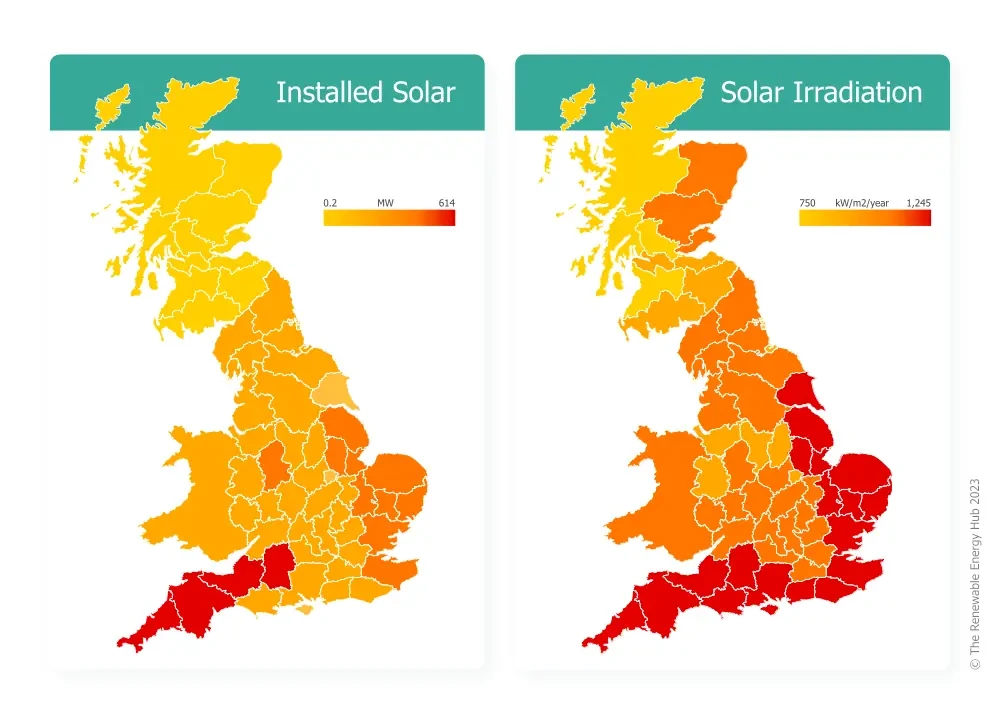
Generally speaking, the peak hours of sunlight are between 11am and 3pm each day, although there can be variations depending on your location. The UK has an average of 4-5 hours of daylight per day, with around 2.5 - 3.5 peak sun hours depending on region and time of year.
Some areas will have more light than others, and there is a bit of a difference between the north and south of the United Kingdom. However, this does not mean that you won’t have less energy production if you live in a shadier area, it just means that you might need more panels in order to achieve the same output.
What you can do for a rough estimate is divide you daily kWh usage by the number of peak sunlight hours in a day. This will leave you with the amount of energy you need to produce in kWh. You can multiply this number by 1000 for the watt usage. Of course, you should also consult your installer about this.
Does solar panel wattage change how many panels you need?
The measure of how much sunlight a solar panel can convert into electricity is referred to as its efficiency. Solar PV panels typically range between 15% and 24.5%. Higher efficiency panels will produce more electricity in a smaller space. Solar panels are efficiency rated based on their output in watts under standard test conditions (STC).
Solar panel efficiency is implicitly considered in the wattage rating of the panel. If a panel is 400w rated, then the efficiency of the panel is already factored in.
Does panel cost influence system size?
It can be difficult to determine how much solar panels will cost you per square foot. This is because there are several factors such as size, type, and quality, that will affect the total cost of the panels. However, it is possible for a tough calculation to be given for the cost per square foot. The prices below include the following:
- Panels
- Installation
- Additional equipment
- Warranty
- Certificate
Here are some example of systems and how much you should be looking to spend.
This will cover an estimated 150 square feet or 14m2. If we are looking at a mid-range system, then the average cost would be £2,775. This works out to £22.12 per square foot.
This will cover an estimated 225 square feet or 21m2. Looking at a mid-range system once again, the average cost for this would be around £5,000 in total. This works out to £22,12 per square foot.
This would cover an estimated 301 square feet or 28m2. Taking another mid-range system, it would cost around £7,000 to install. As a result of this, the cost per square foot would be £23.26.
Should you install extra solar panels for future energy use?
We're going all-electric. As we switch to electric cars and heating, our energy requirements will change. If you anticipate an increase in energy consumption then you can factor this into your calculations. You may want to oversize your system if you're looking at switching to an EV or installing a heat pump in the future.
Conclusion
In short, the number of solar panels you need comes down to how much electricity your home or business uses, the wattage of the panels you choose, and the amount of usable sunlight your roof receives. Most UK homes install between 8 and 14 panels, but the right system size will depend on your usage and future plans. A proper survey will confirm what’s realistic for your property and help you get the best balance between performance and payback.
When should you speak to a solar PV installer?
Consulting with a professional solar installer is essential. They can perform a detailed assessment, consider local conditions, and ensure your system is optimally designed and installed.
Search our database by using the search bar below or simply give us a ring using the number at the top of this page to have a chat. We have specialist software that will calculate a system's output, ascertain the best design, and the varying costs associated with installing solar PV systems on your roof.
Find a local installer
Welcome to the biggest directory of UK renewable energy companies
 How much do Solar Panel Systems Cost? UK Prices 2026